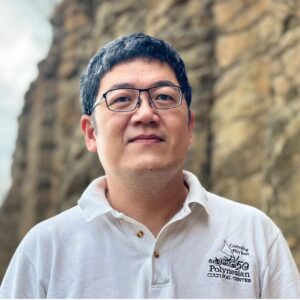
Dr. Ping-Yi Huang has dedicated over two decades to the field of marine science. His deep involvement in marine research and its industrial applications began in 1999. In 2008, he obtained his Ph.D. from the Graduate School of Kuroshio Science at Kochi University, Japan, under the supervision of Professor Masayuki Takahashi. His core expertise spans deep ocean water (DOW) utilization, aquaculture, and marine microbiology.
Following his doctoral studies, Dr. Huang served as a Researcher at the JTL International Japan Research Institute. He subsequently joined the Stone & Resource Industry Research and Development Center (SRDC) under the Ministry of Economic Affairs (MOEA) of Taiwan, where he progressed through the roles of Researcher, Project Manager, and Division Chief. During his tenure, Dr. Huang spearheaded numerous national technology development projects commissioned by the MOEA. His work was dedicated to the commercialization of deep ocean water and the application of DOW resources, encompassing raw material manufacturing, aquaculture, and various biotechnological developments, establishing him as a key driving force behind DOW technology and industrial development in Taiwan.
Within the professional community, Dr. Huang currently serves as a Board Director of the Taiwan Society of Deep Ocean Water Resource Application (TWDOWA) and was honored with the prestigious Society Award from the Association for Deep Ocean Water Applications (Japan) in 2021. After stepping down from his position at SRDC in 2020, he channeled his expertise into the aquaculture technology sector, focusing heavily on integrating DOW into marine farming. In 2024, he founded Matsu Oyster Farm Co., Ltd. and currently serves as its Chairman. In academia, Dr. Huang holds positions as an Adjunct Assistant Professor at Tamkang University and a Researcher and Deputy Executive Director at the university’s Research Center for Marine and Underwater Technology.
Dr. Huang holds multiple patents across Taiwan, the United States, Japan, and China, covering high value utilization technologies such as deep ocean water extracts, low-sodium mineral beverages, and the separation of high-calcium/magnesium mineral water. His publications explore the multifaceted benefits of deep ocean water in aquaculture, biomedical applications, water quality monitoring, and industrial sustainability. He remains deeply committed to advancing regenerative deep ocean water resource applications to strengthen sustainable societal development.